Enneagram
Nine classical role types popular in self-story and coaching — motivation and the role you give, not a trait score sheet.
Straight there
Our quick take · 17/25 · not psychological advice
- Quick insights
- Scientific validity
- Comprehensive
- Memorability
- Speed
About
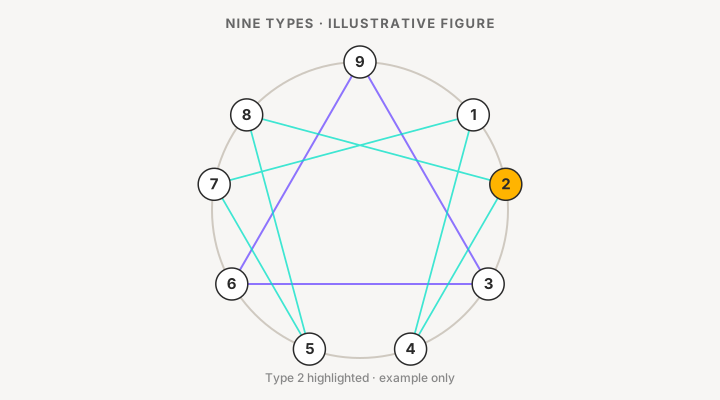
The Enneagram describes nine classical role or motivation types — the nine Enneagram types. Each type is a story about what you tend to want, fear, and protect: the role you give other people. The figure below is the familiar nine-point diagram people use to place those types (Type 2 is highlighted as an example only).
The nine types have widely used public nicknames. Type 1 is often the Reformer: standards, improvement, getting things right. Type 2 is often the Helper: care for others, being needed, warmth. Type 3 the Achiever, Type 4 the Individualist, Type 5 the Investigator, Type 6 the Loyalist, Type 7 the Enthusiast, Type 8 the Challenger, Type 9 the Peacemaker. The names are not the whole result — good forms score all nine and show how close the others run.
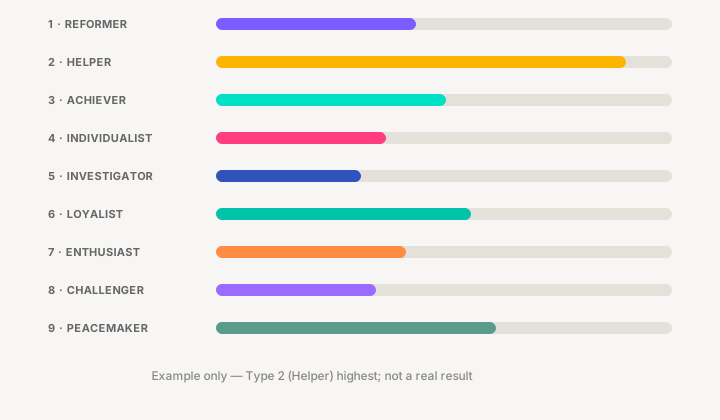
A concrete picture: someone whose highest bar is Type 2 (Helper) may recognise themselves as the person who notices who is left out of the room, who steps in with practical care, and who can lose track of their own needs while doing it. Someone whose highest bar is Type 5 (Investigator) may recognise the opposite shape: pull back, gather knowledge, keep a private store of energy and attention. Same kind of map — different role given to the world.
The strength of this tradition is that those roles are easy to tell as stories. Coaches and teams use them as a shared language. It is a motivation and role map, not a clinical label.
Background
The modern Enneagram of personality grew from mid-twentieth-century teachings on ego patterns (figures such as Oscar Ichazo and Claudio Naranjo are often named in that history), then spread widely through workshops, books, and coaching. There is no single peer-reviewed standard questionnaire the way the Big Five has IPIP-style item pools — the tradition is carried more in practice and popular writing than in one lab instrument.
Research still finds some structure in people’s answers — the nine types are not random story labels — but the evidence base is thinner than for well-established trait models. You are sorting motivation and role, not drawing a continuous trait spectrum.
We host a short open Enneagram form built from Open Psychometrics development material: seventeen items, scores across all nine types, highest type as the headline. It is a short form, not the full long banks some research lists use. Take it when you want the classical nine-type result in plain language.
Strengths
It is memorable. Nine roles with plain nicknames are easy to retell in coaching, teams, and self-story.
It speaks to motivation: what you reach for and what you defend — the role you give — rather than only how energetic or organised you are.
Better forms score all nine types, so you see a profile of heights and near-misses, not only a single stamp. Close second types often matter as much as the headline. The chart below is an example Helper-led profile (not a real result).
A large coaching literature means many people already arrive with language for Type 2 care, Type 8 force, Type 9 ease, and the rest — less time spent inventing a shared vocabulary.
Weaknesses
It is not well researched by mainstream trait-science standards. There is no single gold-standard academic instrument the way large public item pools back continuous personality traits. Forms differ in length and quality; treat any short quiz as a first look, especially if retests move your top type.
It is not a trait measure. It sorts motivation and role stories into nine types. That is a different job from continuous trait scores — useful for self-story and coaching language, weak if you treat a type number as a full temperament readout.
Nine boxes invite stereotypes. “I’m a Helper” can become a script instead of a sketch. Use scores, wings or close picks where you have them, and leave room to grow.
It does not cover high sensitivity, current mood, or skills you have learned. Those need other measures. Some profiles sit between types or feel mis-sorted by a forced headline.
The www way
On what-world-way, the only way we test this territory is What — not as a side option beside Enneagram, but as our full measure of the role you tend to give. What uses eleven animals. Nine of them grew from the same kind of role-type structure people know from the Enneagram; we rebuilt the language into plain roles (for example Stag as Steward, Dolphin as Companion, Owl as Sage) rather than clinical type numbers. Two more animals — Beaver (Builder) and Chameleon (Open) — fill gaps the classical nine do not hold cleanly.
So if you take What, you are not “also” sampling this area with a second system for us: What is the test. Glimpse is short; Insight and Deeper use more questions under the same animals. All depths are free. The animals and roles are on the What page; the tests sit on Build your profile.
Want the original?
Our short form is derived from Open Psychometrics OEPS development data from the Open Psychometrics Project — seventeen multi-keyed items, not the full long OEPS item banks.
If you want the classical nine-type Enneagram result, use our short open Enneagram test. You get scores across all nine types, with the highest type as the headline (for example Type 1 — Reformer, or Type 2 — Helper), not only a single number without context.