Five broad personality traits used across research psychology — continuous scores, not a single type box.
1 of 4 · Traits and temperament
Straight there
Our quick take · 16/25 · not psychological advice
- Quick insights
- Scientific validity
- Comprehensive
- Memorability
- Speed
About
The Big Five (also called the five-factor model) is the main research standard for personality traits. It describes people on five broad dimensions, often remembered with the letters OCEAN: Openness, Conscientiousness, Extraversion, Agreeableness, and Neuroticism (sometimes framed as emotional stability when the score is read the other way up).
Openness is curiosity and interest in ideas and experience. Conscientiousness is order, duty, and follow-through. Extraversion is social energy and pace. Agreeableness is cooperation and warmth toward others. Neuroticism is how strongly stress and negative feeling land — lower scores often read as steadier mood under pressure.
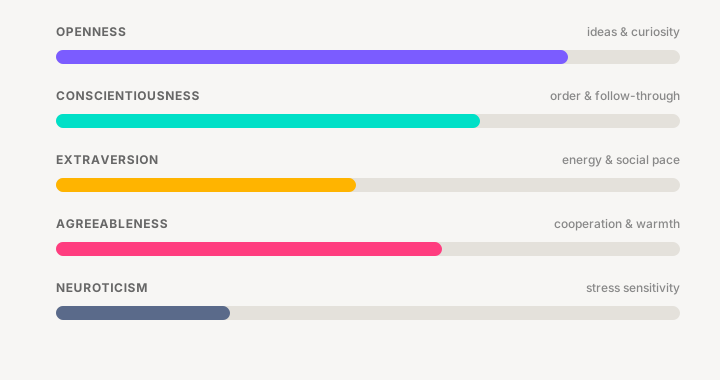
Unlike a single personality type code, each trait is a score on a continuum. Two people can both be “extraverted” and still sit far apart on the scale. The diagram below is an example Big Five profile: high Openness, solid Conscientiousness and Agreeableness, mid Extraversion, and lower Neuroticism.
When people say they want a proper personality test, they often mean something built on this evidence base — continuous trait scores rather than one box for the whole person.
Background
The Big Five grew from decades of work on everyday language for personality and on questionnaires that measure it. Researchers including Gordon Allport, Raymond Cattell, and later Lewis Goldberg developed the idea that broad trait factors appear again and again in ratings of people.
Paul Costa and Robert McCrae built widely used five-factor questionnaires that helped fix the five dimensions in research and practice. Lewis Goldberg’s International Personality Item Pool (IPIP) put free item sets in the public domain so many labs and sites could run a Big Five test without a commercial licence.
Twin and long-term studies support a strong genetic influence and rising stability of adult trait levels, while still leaving room for real debate about how much change is possible. Business and coaching also use simpler personality type tools; those are easier to talk about in a workshop but sit on a thinner research base than the Big Five.
Strengths
It is the most replicated model of personality traits in research psychology. Journals, universities, and many professional tools use the same five dimensions, so results can be compared across studies.
Scores are continuous. That helps coaches and researchers see strength of a trait and avoid forcing everyone into a hard type box.
The five dimensions are broad enough for a first full trait picture, and many longer inventories still report the same five at the top level before adding finer facets underneath.
The OCEAN letters make the five personality traits easier to remember for people who already know the system, while the full names keep the meaning clear for newcomers.
Weaknesses
Domain scores alone are coarse. Two people with the same Extraversion score can still differ a lot once you look at facets (for example social warmth versus assertiveness). Longer tests add those layers; short tests often stop at five numbers.
Self-report has limits. People answer how they see themselves, which can drift with mood, honesty, or what they wish were true. Treating scores as a starting sketch for conversation is safer than treating them as a final stamp.
The name Neuroticism can sound harsher than the research construct. Many write-ups pair it with emotional stability so the dimension is not heard only as a flaw.
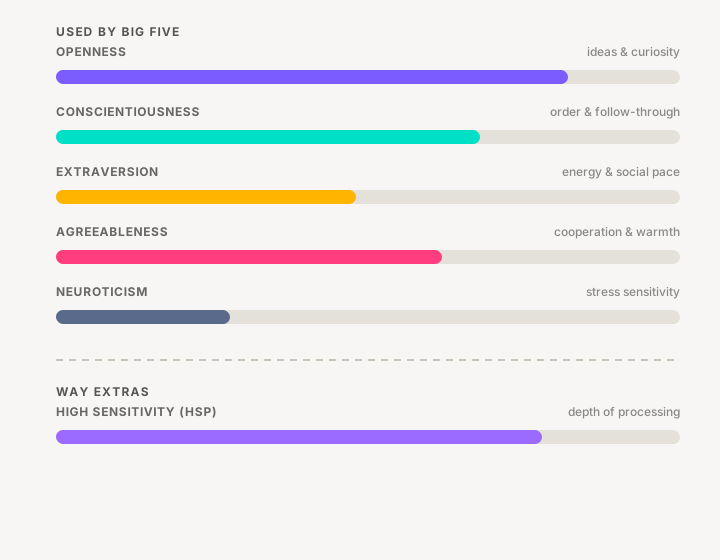
It uses all five Big Five scales — and still does not cover everything people care about. High sensitivity (HSP), skills, motives, and how you are this week sit outside a plain Big Five profile — useful extras, not a reason to throw the five away.
The www way
Academic research on personality traits finds strong clusters: people’s scores tend to bunch into a few common shapes rather than spreading evenly. Way follows that idea. Large studies (including Gerlach and colleagues, 2018) found four dense peaks in Big Five space. We name related ways Bold, Bright, Warm, and Steady, and we add further ways — including Keen for high sensitivity — so more people have a clear home. White is the balanced or between-peaks register.
Way is built on Big Five ground but reports eight ways of moving with close picks, not only five raw scores. Insight-style Way summaries keep the five trait scores and add high sensitivity (HSP) as an extra measure. Way is free at every depth. Glimpse is short; Insight and Deeper use more questions on the same model. The eight ways are on the Way page. The Way tests sit on Build your profile.
Want the original?
Our free Big Five test uses items from the International Personality Item Pool (IPIP) — Goldberg’s Big-Five Factor Markers, public domain.
If you want the classic five continuous scores, use our free Big Five test. You get a profile across Openness, Conscientiousness, Extraversion, Agreeableness, and Neuroticism — not a single type code.