Sixteen personality types from four pairs of preferences — a well-known first personality test.
2 of 4 · Traits and temperament
Straight there
Our quick take · 16/25 · not psychological advice
- Quick insights
- Scientific validity
- Comprehensive
- Memorability
- Speed
About
A Jungian personality type is a four-letter code. Each letter is a preference on one pair of poles. Together they make one of the sixteen personality types people often talk about online and at work.
The four pairs are: Extraversion (E) or Introversion (I) — where you draw energy, from people and activity or from quiet and focus. Sensing (S) or Intuition (N) — how you take in information, facts and detail or patterns and possibility. Thinking (T) or Feeling (F) — how you decide, by logic and criteria or by people and values. Judging (J) or Perceiving (P) — how you like outer life, settled plans or open options.
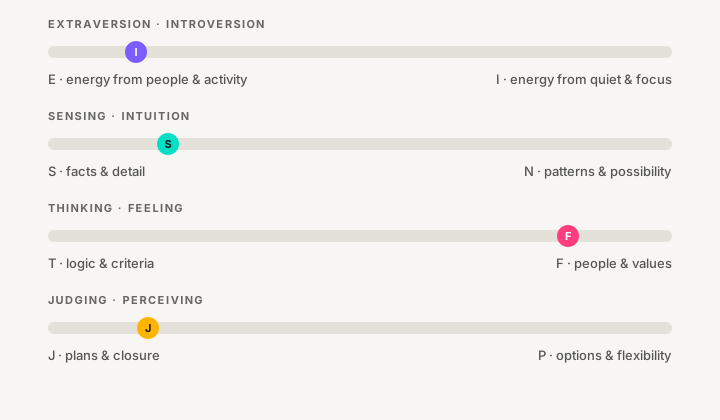
Pick one side of each pair and you get a code such as ESTP or ISFJ. Popular sites that focus on the Jungian sixteen personalities made these codes easy to share. The diagram below is an example of an ISFJ result: Introversion, Sensing, Feeling, and Judging — often a careful, practical, people-minded pattern. Our free Jungian test returns the four letters plus a score on each pair.
It is a simple picture of preferences that many people find easy to recognise — useful for self-story and teams, not a full research profile of personality traits on its own.
Background
Carl Jung (1875–1961) was a Swiss psychiatrist. In Psychological Types (1921) he described attitudes and functions that later writers turned into the four preference pairs above.
Two American students of that tradition, Katharine Cook Briggs and her daughter Isabel Briggs Myers, built a practical questionnaire and type language from Jung’s ideas. That work is why many people still call four-letter results a Myers Briggs test.
Mid-century and later popular tests made the sixteen personalities common in organisations and on the web.
Strengths
It is popular and well known. Many people have already met a four-letter personality type at work or on popular sites that teach the Jungian sixteen personalities.
Coaches and facilitators who spend time with the system find the sixteen personality types easy to remember and to use in conversation. Many lists give each code a nickname or archetype — for example ESTP as the Entrepreneur — which helps a first talk start without a long theory lesson.
Better Jungian tests give a score for each pair, not only the final letters. Those scores help coaches avoid hard boxes and see how close someone sits to the middle of a pair.
The poles show up in ordinary work. An outgoing sales style (more Extraversion) and a quieter accounts style (more Introversion) are easy to spot. Basic awareness of that difference can reduce friction and help people work with each other rather than against each other.
Weaknesses
The four letters are rather opaque unless you spend time learning what E, S, T, and J stand for. Without that learning, the code is just a puzzle.
Many people score near the middle on one or more pairs. A small shift on a retest can flip a letter and change the whole type. Treat letters as a starting sketch, not a fixed stamp — and use the pair scores when you have them.
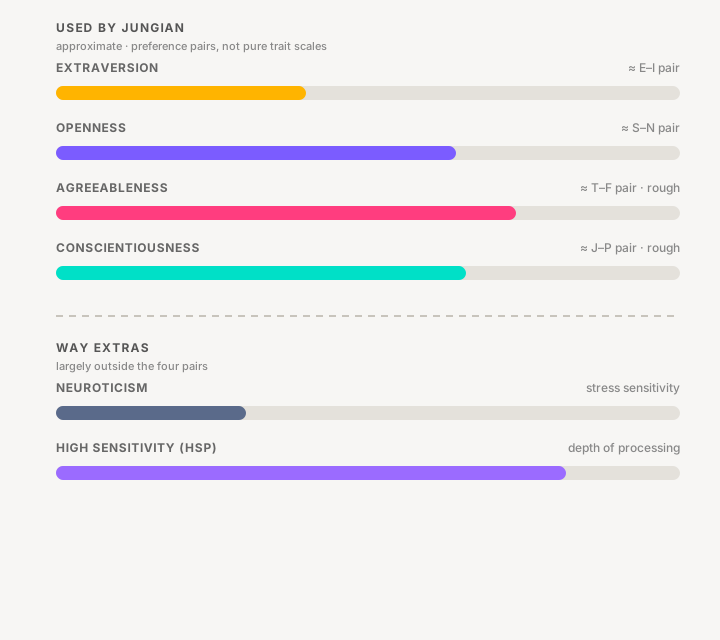
It only uses about four of the five Big Five personality trait scales — and only approximately. The pairs map loosely onto Extraversion (E–I), Openness (S–N), Agreeableness (T–F, rough), and Conscientiousness (J–P, rough). They are preference poles, not pure trait scores. Neuroticism (emotional stability) is largely left out. High sensitivity (HSP) is outside the four-letter code as well.
A lot of people only take away their four letters, forget what each pole means, and the write-up goes in a drawer. Keep the scores and the story, not only the code.
There is a real risk that the sixteen headline types get used as stereotypes without the deeper scores — as if one code explained everything. The letters are a start, not the whole picture.
The www way
Academic research on personality traits finds strong clusters: people’s scores tend to bunch into a few common shapes, not sixteen equal boxes. Way follows that idea. We recognise the four strongest trait clusters from large studies, and we add further ways so more people have a clear home. The same idea runs through What as well.
Way is eight ways of moving, built on Big Five ground. Results use clusters and close picks rather than a single forced letter. The chart below is an Insight-style sketch of Big Five coverage: the four scales Jungian pairs largely touch (Extraversion, Openness, Agreeableness, Conscientiousness), then a gap, then Neuroticism and high sensitivity (HSP) as Way extras. The split is approximate — pairs are preference poles, not one-to-one trait scores (T–F and J–P are the rougher links). Keen is the Way that makes room for high sensitivity.
The eight ways are on the Way page. The Way tests (Glimpse, Insight, Deeper) sit on Build your profile.
Want the original?
Our free Jungian test is the Open Extended Jungian Type Scales from the Open Psychometrics Project.
If you want the classic four-letter Jungian result, use our free Jungian test. It is short (about thirty-two either-way picks). You get the four-letter type plus a score on each pair, so you can see strength of preference — not only the headline code.