Four behavioural styles used a lot in workplaces — quick to learn, thinner as a full personality trait test.
3 of 4 · Traits and temperament
Straight there
Our quick take · 17/25 · not psychological advice
- Quick insights
- Scientific validity
- Comprehensive
- Memorability
- Speed
About
Marston’s four behavioural styles are a short picture of how people tend to behave, especially at work. The four styles are Dominance, Influence, Steadiness, and Compliance (some versions use a close word for the fourth style). You get a short profile of how strong each style is, often with one style highest.
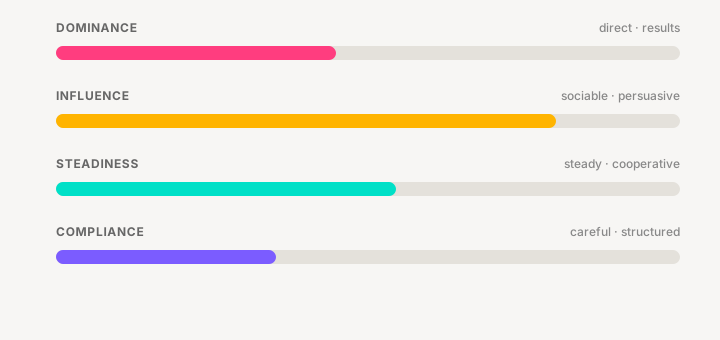
Dominance is direct and results-focused. Influence is sociable and persuasive. Steadiness is patient, steady, and cooperative. Compliance is careful, accurate, and structured. These are self-reported behavioural tendencies — how you tend to show up — not a full set of personality traits like the Big Five.
The diagram below is an example profile with Influence highest: more energy in people and persuasion, with the other three styles lower. Many workplace tests built on this model are what people mean when they say they took a four-style or DISC-style test.
The four styles are easy to learn in a short workshop. They are not a substitute for a continuous trait profile or a three-part what-world-way portrait.
Background
William Moulton Marston (1893–1947) published Emotions of Normal People in 1928. In that book he described four ways people tend to respond and behave. Later workplace tools turned those ideas into short questionnaires and the four-style language many teams still use.
People often call the model DISC from the first letters of the four style names. Commercial products built on it vary in quality and wording. The public-domain dimension names and Marston’s original book are free to use.
Research support is thinner than for the Big Five. The four-style approach is strongest as a shared language for communication and team habits, not as a comprehensive science of personality traits.
Strengths
It is quick. Many forms are short enough for a half-day workshop or a first team conversation.
It is easy to remember. Four styles are few enough that most people can hold them in mind — easier to retell than five continuous Big Five numbers or sixteen personality type codes.
It is practical at work. Labels like “more Dominance” or “more Steadiness” give a simple handle for how someone prefers to push, persuade, support, or check detail.
It gives coaches and managers a common vocabulary without needing a long theory brief first.
Weaknesses
It is not comprehensive across life. Four workplace-leaning styles leave out much of motivation, worldview, and deeper personality traits. No single short grid covers a whole person.
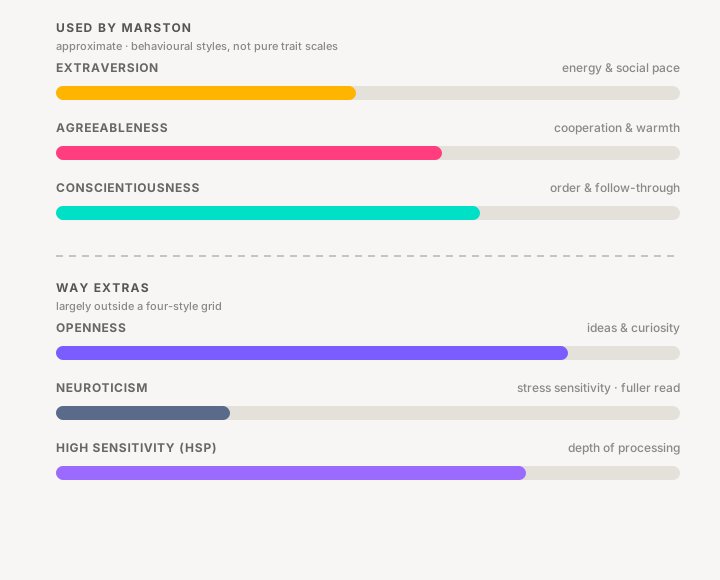
It only uses about three of the five Big Five personality trait scales — and only approximately. Marston styles are behavioural blends, not pure trait scores. They largely pull on Extraversion, Agreeableness, and Conscientiousness (for example high Influence tends to sit with higher Extraversion and Agreeableness; high Compliance with higher Conscientiousness). Openness is the clearest miss. Neuroticism (emotional stability) may touch Steadiness a little, but a four-style grid is not a full stress-sensitivity scale. High sensitivity (HSP) is outside it too.
Scientific validity is thinner than the Big Five. Different commercial forms are not all equal; treat the result as a sketch of behavioural style, not a gold-standard trait measure.
People can overuse a single letter or colour as a stereotype — “you’re a D” — and stop listening to situation, skill, or change. Pair scores help, when the test provides them.
Self-report still applies. How you answer on a quiet day may not match how you behave under deadline or in a new role.
The www way
For a fuller trait read we use Way — eight ways of moving on Big Five ground, with clusters and close picks rather than only four workplace styles. The chart below is an Insight-style sketch of Big Five coverage: the three scales Marston styles largely touch (Extraversion, Agreeableness, Conscientiousness), then a gap, then Openness, a fuller Neuroticism read, and high sensitivity (HSP) as Way extras. The split is approximate — styles are blends, not one-to-one trait scores. Keen is the Way that makes room for high sensitivity.
The eight ways are on the Way page. The Way tests sit on Build your profile. Life activity is the place for work, leadership, and contribution more broadly.
Want the original?
Open Circle uses Marston’s four-style model (1928) and items from the International Personality Item Pool (IPIP), public domain.
If you want a short four-style behavioural profile, use our free Open Circle test. You get scores on Dominance, Influence, Steadiness, and Compliance, with the highest style as the headline.
Open Circle is an open equivalent of the familiar four-style workplace model: Marston’s public-domain style names, with items from the International Personality Item Pool (IPIP).